Keeping Firearm Training Certificates and Course Records Organized
In many cases, paperwork from training classes is left behind after the class, because it has served its purpose. But it's not a bad idea to keep track of your training, and the certificates you receive. Most important is to make sure you have a record of your training, but you don't want to imply more than you have. The type of record keeping you can use will depend on how often you go to the range, if you have a family, and whether or not you are computer literate. As with any paperwork for Oregon gun owners, we recommend that you keep accurate records, keep personal info out of unnecessary documents, and verify information with the relevant state or federal agency when verifying requirements for training.
Decide what belongs in the file
For each course you complete, you should include documents in your training folder that help you to remember the date and subject matter of your training. This could include the document that was issued to you as proof of completion of your course such as a certificate, brochure, instruction manual, or even a receipt for registration for the course, a copy of the course outline, a copy of the range log for the time you were at the range for your training, and even your own notes regarding the type of training you received and what you had to do in order to complete the course.
The intention of keeping these training documents is to help you to remember what training you have had and to recall specific details about each course such as the date it was delivered, the general subject matter and specifically what skill(s) you may need to practice to better your shooting.
Keep your notes for the above points factual. If you write out what you learned in a training session for example that you practiced loading and unloading under supervision of an instructor then that is more useful than saying it was a good class. Do not add any sensitive information that you have no intention to use for anything. For example do not record the full home address of someone on a range for example, nor the serial numbers of all guns at a shooter's home, nor copies of ID for example.
Paper, digital, or a combination
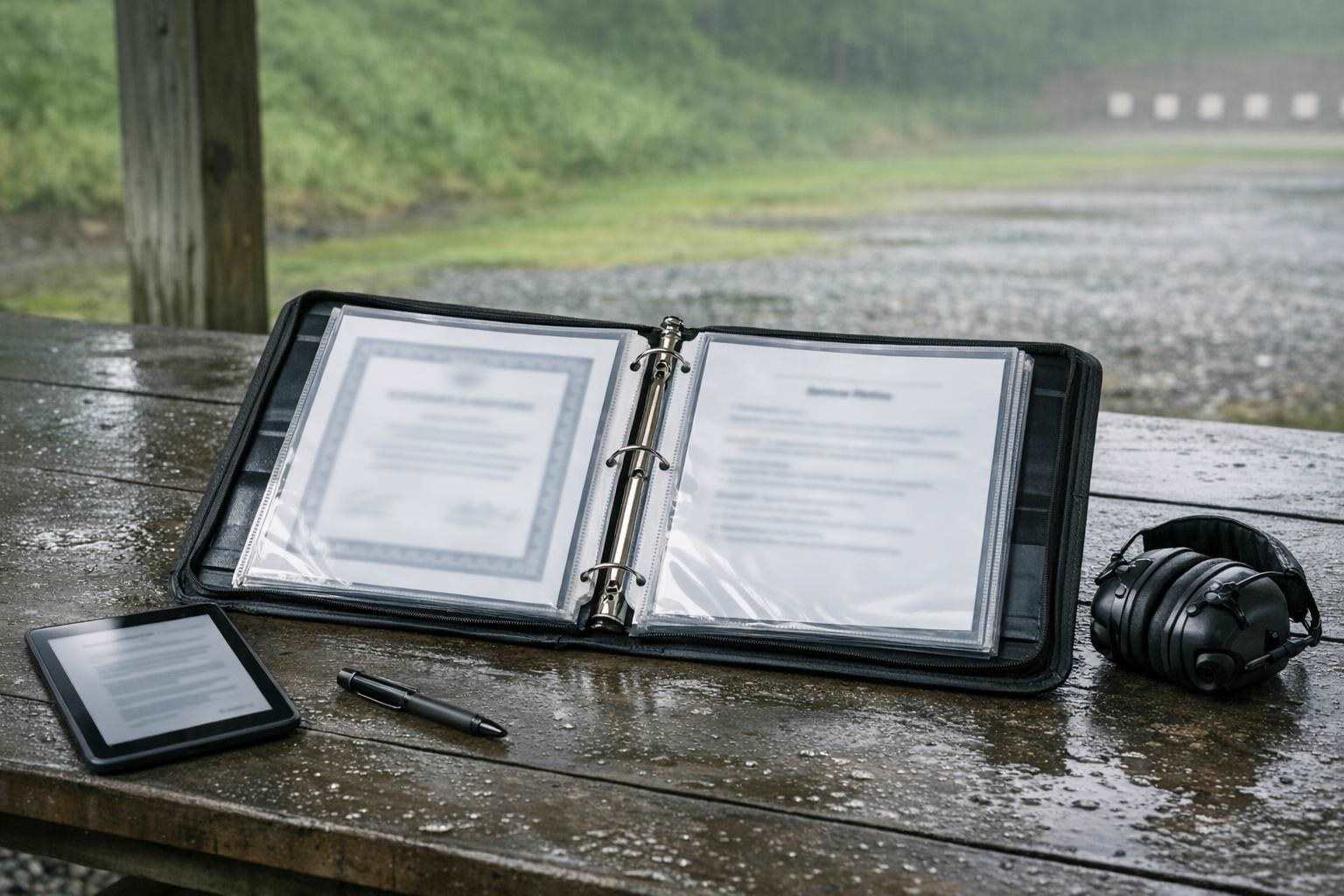
Paper training records can be stored in a labeled binder or in an expanding file in a secure location of your home. You can add sleeves to hold the printed certificates to prevent damage over time.
Storage of training documentation can be digital. All relevant documents (i.e. scanned certificates, course outlines, a simple training record spreadsheet) can be easily searched and be backed up. File names for digital documents should be clear and descriptive (e.g. "optic-manual-model-date.pdf"). A second backup of the document should be made and stored separately from the primary document.
For many owners, it will make sense to keep original copies of all training paperwork and then scan the documents for easier use and to create a useful record of training. The main cost of keeping such records is to take a little time to set them up in the first place.
You should choose something to record your training in and to write up your range records in that is simple enough to continue to use in the long term. A complex database to record every trip to the range would probably be too hard to continue to enter every visit to the range. A simple spreadsheet or even a calendar would be much better.
Build a record that helps with future decisions
After a training session, take a few minutes to record the main points from the session in a simple note while the details are still fresh. Write down what you were able to complete during the course, and what wasn't covered (possibly to practice in the future). Determine if you still need further coaching for certain topics or not. This will help determine whether you need to repeat a basic fundamentals course, go for a supervised skills session, or get some specialized training.
Just because maintenance records and course records are separate, does not mean that they should be stored in completely separate folders. Rather, it is wise to set up the folders in such a way, that reference to the other folder is easily possible.
As for paperwork to keep at home, training for each person in the household should be recorded in a separate section. This means one person's certificate does not get confused with another person's. Also, it is best to limit access to these documents to people who actually need them.
Most importantly a calendar reminder to look at the relevant Course Records on the anniversary of when the Certificate was issued for the period of time that the course is stated to last for, but then only for the purpose of establishing whether any refreshers are required as a result of skill, gun, ammunition or any other relevant circumstances having changed in the intervening period. The renewal/expiration period for any formally recognized qualification must be confirmed with the current relevant official governing body.
Protect privacy without losing access
For maximum privacy training documents should contain minimal information about other individuals. For physical documents this means they should not be left in unlocked vehicles and documents containing contact information etc. should not be stored in publicly accessible locations. Digital copies of such documents should be access restricted (e.g. password protected) and not shared via public links.
Remove identifiable information from a document only if doing so would not render the document useless. Store a full, unaltered copy of original documents in a safe place. Use a redacted copy for normal distribution of a document.
It is also important to note that a law governing documentation of proof of training for shooting sports may change significantly at any time. As a result, always consult the latest official source for such information in all situations where documentation of training is required for official purposes.
Review the system before it becomes a problem
Minutes after the class end, scan and file all certificates, rename all copies of digitally saved documents and make a simple note of the training received. That a few minutes of your time are required to avoid having a pile of unknown training documents lying about is obvious.
Every 6-12 months, verify that you can open your training files, that you have a copy of the back up file(s) and that your printed training certificates are in readable condition. Remove duplicate copies of the same certificate and make any obvious errors to dates or course names. Make sure all of your training records are for the correct person.
Remember that an effective firearms training record is not one that has a lot of fields to complete, but rather a record that accurately maintains information to aid an owner in the best possible training decision for future growth in shooting. It must remain simple, accurate and retrievable.